


Postdoctoral Researcher Joseph Keller, iEcoLab alum Sebastiano De Bona, and Dr. Matthew Helmus have published a new paper in NeoBiota: “Leveraging spatial scale and temporal variation to track the spread rate of invasive spotted lanternflies (Lycorma delicatula).”
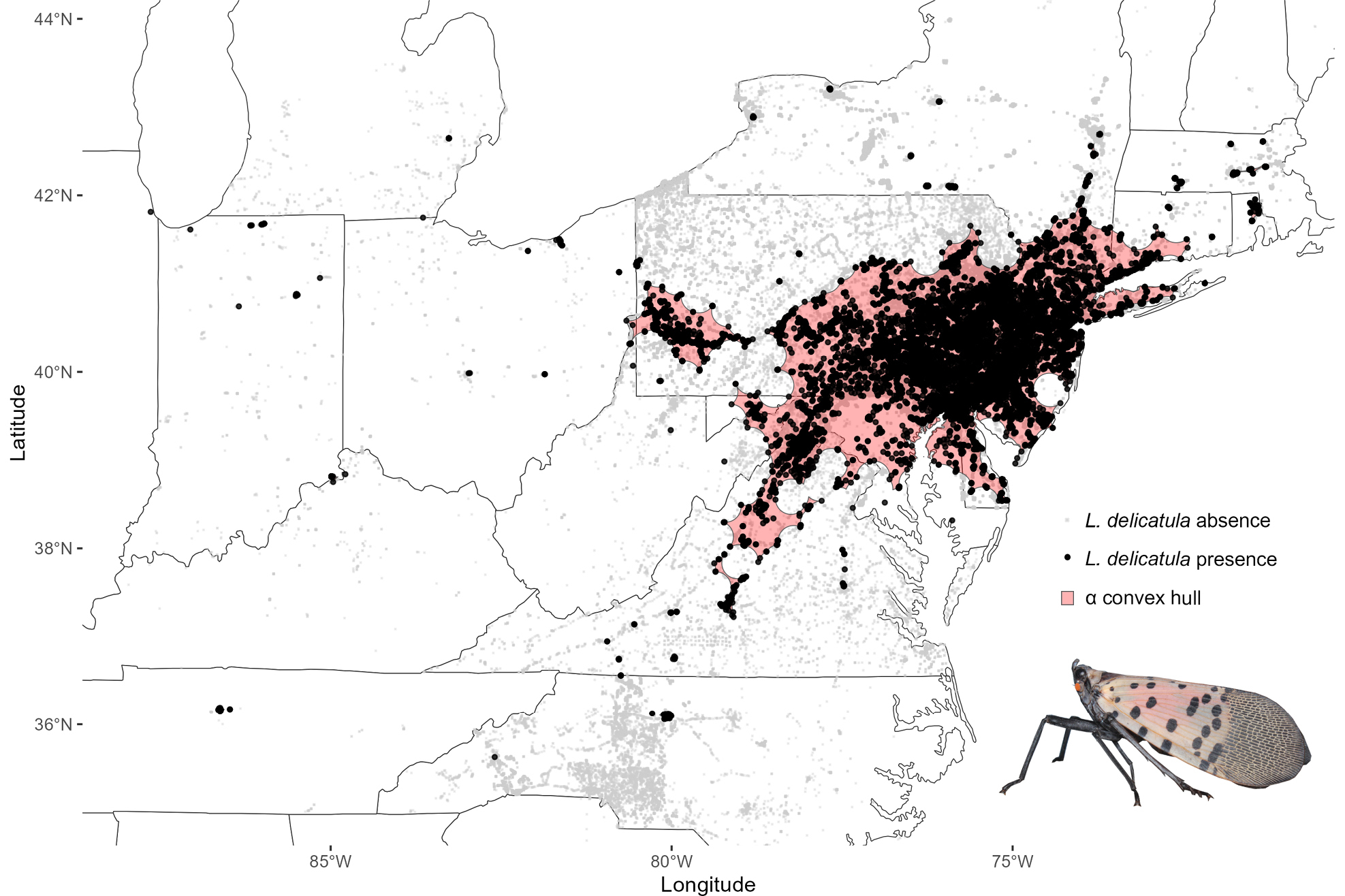
Using more than 900,000 occurrence records from 2014 through 2023, the team tracked the spread of spotted lanternflies from eastern Pennsylvania to an invasion front in Chicago. Their analyses show that estimated spread rates change with the spatial scale used to define an invasion boundary.
The study also found that logistic models captured a slow–fast–slow pattern of spread better than simple linear models. Satellite populations similarly accelerated before merging with the primary invasion, reinforcing the importance of early intervention while new invasion centres are still expanding slowly.
Read the open-access paper in NeoBiota: https://doi.org/10.3897/neobiota.106.177041